A pharmacy chain where every branch kept compliance its own way
A system for managing staff, deliveries and documentation across a pharmacy network – reachable from any branch, with one shared time record.
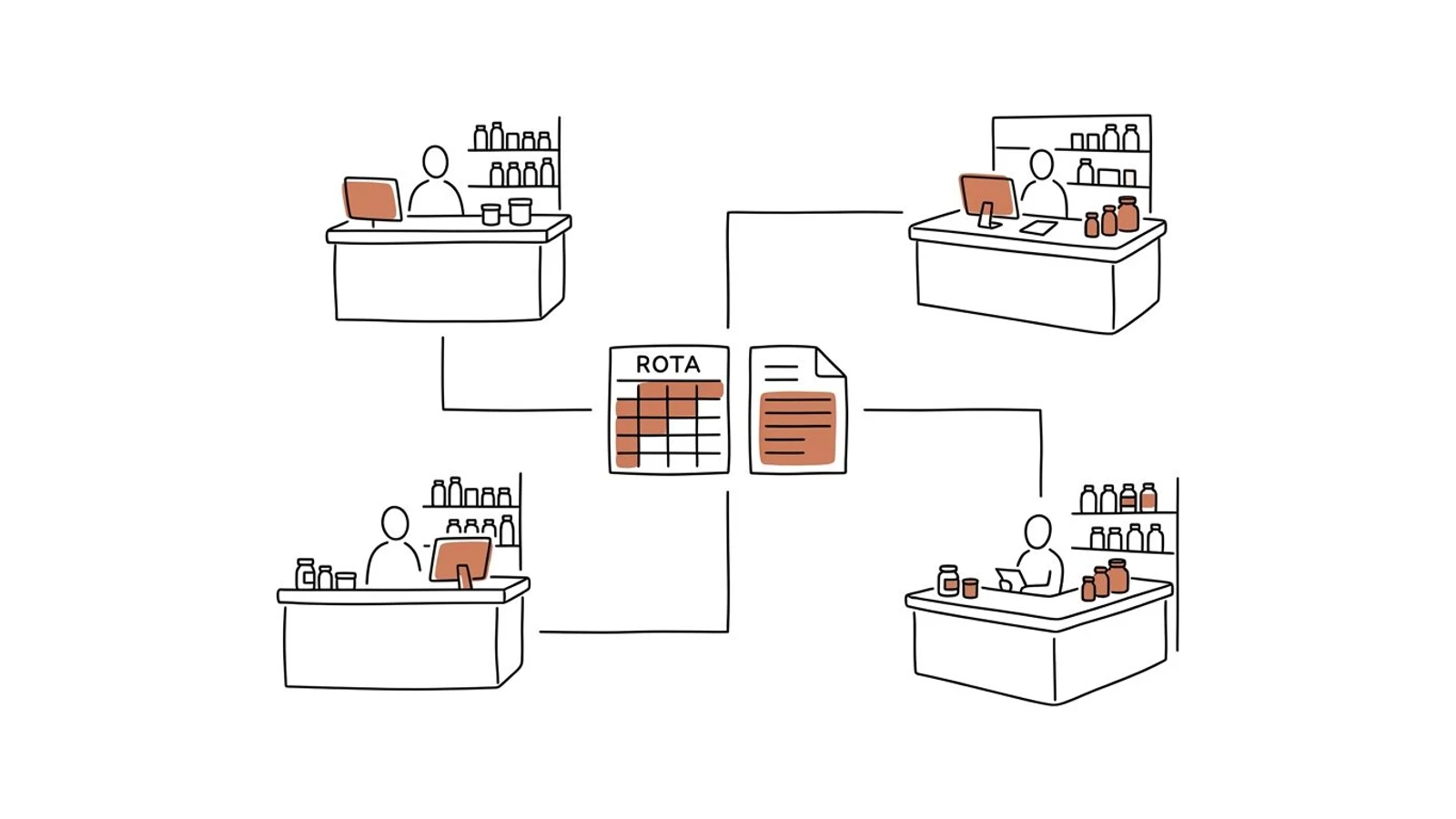
A pharmacy operates inside a dense mesh of requirements: working time records, staff qualifications, goods receipts, documentation, inspections. A single branch manages that with notebooks and spreadsheets. A chain of a dozen branches does not manage it at all, because each one does it differently.
What it looked like before
Every pharmacy kept its own records its own way. The rota in a spreadsheet, qualifications in a binder, documents on the computer in the back room. Head office, wanting to check anything across the network, had to ask branch managers for summaries and wait.
The expensive part was not gathering the data. It was what happened during an inspection or a stand-in. A manager covering another branch for a week started by learning someone else’s filing habits.
What we built
Tasks and monitoring. Recurring duties are set up once, and it is visible whether they were done, in which branch and by whom.
Secure document storage. Documentation available from any branch, with control over who can see what. Covering a shift stops meaning hunting for a binder.
Consistent working time records. One method of recording across the network, instead of a dozen variants of the same spreadsheet.
Compliance monitoring. An overview of what is met and where, without polling managers branch by branch.
Delivery management. Goods receipts handled in the same system as everything else, so the delivery history is where people look for it.
What changes day to day
The gain does not come from the data being on a computer. It comes from it being the same in every branch.
Uniform records mean a stand-in costs an hour rather than a day. An inspection at one pharmacy is no surprise to head office, because the compliance state was visible beforehand. And comparing two branches is meaningful, because the numbers were produced the same way.
For the pharmacist the change is simpler: access to what they need from wherever they happen to be working, instead of from one particular computer in one particular back room.
Why we built it this way
With staff data and healthcare documentation, permissions are not a feature but a foundation. The system is therefore built around roles: who sees their own rota, who sees the branch rota, and who sees the whole network. Adding another pharmacy is configuration rather than reconstruction – which is the condition for a system like this to make sense as the chain grows.
Show the technology stack
- Angular
- Ngrx
- RxJS
- Angular Material
- HTML5
- CSS3
- JIRA